


Decades-Old Mystery: Live WWII Bomb Found on Ajay River Bank Jolts Quiet West Bengal Village
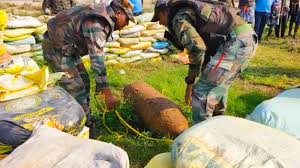
Bolpur, West Bengal: A quiet village near Bolpur in West Bengal’s Birbhum district was jolted into disbelief this week after a live World War II-era bomb was unearthed, its rusted shell carrying echoes of a long-forgotten past.
The explosive, discovered by local fishermen on the banks of the Ajay River in Laudaha village, lay hidden for decades. Laudaha is located just miles from the hallowed grounds of Visva-Bharati University, founded by Rabindranath Tagore. What initially appeared to be a harmless metal cylinder soon revealed itself as a dormant, yet still very much active, remnant of history.
Alerted by villagers, the local police swiftly cordoned off the area, urging residents to maintain a safe distance. The army was immediately called in from a nearby base. After a careful inspection, the bomb was safely detonated under the supervision of Central forces on Wednesday.
The controlled explosion shattered the stillness of the countryside, with its force so intense that tremors rippled through neighbouring villages. “There was panic in the area since the bomb was discovered,” said a senior Birbhum police officer. “We cordoned off the site for safety. The situation is now normal after the successful neutralisation.”
The discovery has left both experts and locals puzzled. The bomb, likely British-made and dropped during World War II in the 1940s, had remained undisturbed and active for over eight decades on the quiet banks of Bolpur.
The incident has drawn eerie parallels with a similar discovery in Jhargram district last year, where another World War II bomb was recovered during digging operations. Officials had then traced that bomb’s origin to an abandoned wartime airstrip, which was used for fighter planes where pilots would often jettison bombs to reduce weight before landing.
