


Conference on Air Power Technology Stresses AI, Electronic Warfare, and Next-Gen Propulsion for Aerospace Dominance
New Delhi, India: Defence Secretary Rajesh Kumar Singh today stressed the critical need for a structured policy framework to fortify India’s domestic industrial base through a balanced synergy between the public and private sectors.
Delivering the inaugural address at the ‘Strategic Insight Conference on Indigenous Development of Critical Technologies for Air Power’—organised by the Centre for Aerospace Power and Strategic Studies (CAPSS)—Shri Singh reaffirmed the Government’s commitment to Aatmanirbharta (self-reliance) in defence. He emphasised that diversifying the industrial base will effectively end monopolies, enhance the ease of doing business, and spur innovation across the entire defence ecosystem.
The Defence Secretary highlighted the specific importance of developing advanced aero technologies, conducting field evaluation trials, and creating long-range air-to-air missile systems to bolster India’s air power capabilities.
Echoing the focus on indigenous capability, Vice Chief of the Air Staff Air Marshal Narmdeshwar Tiwari highlighted the strategic impact of air power, citing Operation Sindoor as an example of its ability to determine strategic results. Air Marshal Tiwari asserted that in addition to designing and developing indigenous aircraft, India must prioritise expertise in electronic warfare, advanced sensors, radars, and data links.
Further insights came from Dr. K Rajalakshmi Menon, Director General, AERO, DRDO, who focused on disruptive technologies. She pointed to the potential of UAVs, multi-sensor fusion, and artificial intelligence in air operations, alongside advancements in stealth technology and the integration of quantum, photonic, and blockchain technologies in defence systems.
DG, CAPSS Air Vice Marshal (Retd) Anil Golani underscored that developing intelligent control propulsion, super-cruise capability, and fly-by-light systems would define the future of India’s aerospace dominance, especially in a competitive neighbourhood.
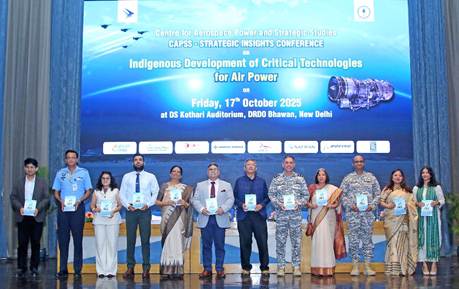
The event, which saw the Defence Secretary release the book ‘Asian Defence Review 2025: Geo-political Shifts and Strategic Partnership Multilateralism in the Indo-Pacific’, included multiple technical sessions on indigenous jet engine co-development, fighter aircraft programmes, and unmanned systems. The conference served as a key platform for senior officials from the Ministry of Defence, the Indian Air Force, DRDO, and industry leaders to discuss the roadmap for achieving technological self-reliance.
