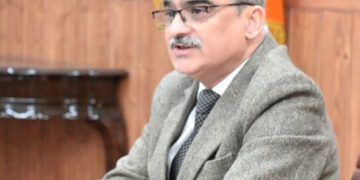



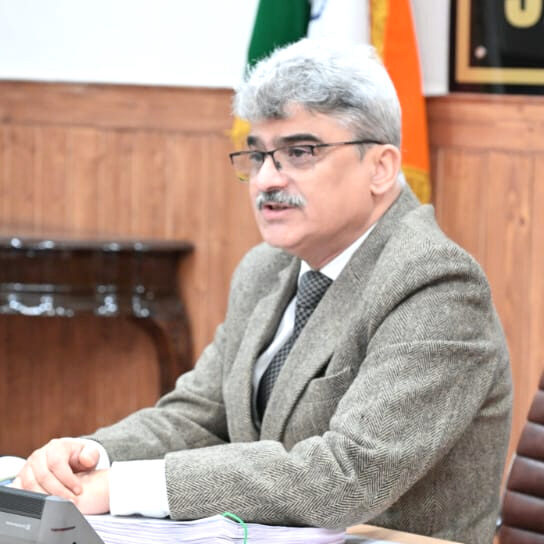
Chairs 15th UT level NCORD Committee meeting to assess the ongoing efforts by deptts
SRINAGAR: Chief SecretaryAtal Dullootoday chaired the 15th Narco Coordination Centre (NCORD) meeting to review the ongoing efforts and coordinated measures being taken to curb the menace of narcotics trafficking and substance abuse across the districts of Jammu and Kashmir.
The meeting was attended by Additional Chief SecretaryHigher Education Department; Director General of Police (DGP); Additional Director General of Police (ADGP)CID; Principal SecretaryHome Department; and other senior officers from the civil and police administration.
Deputy Commissioners (DCs) and Senior Superintendents of Police (SSPs) from all districts participated through video conferencing.
At the outsetthe Chief Secretary underscored the critical importance of strengthening the legal and institutional framework to ensure higher conviction rates under the NDPS Act. He directed the Police and Law Departments to collaborate closely to devise a strategy for improving prosecution outcomes.
The Chief Secretary further called for developing an AI-enabled system to assist in the preparation of watertight charge sheets and directed IGP Jammu to lead the development of this module in coordination with the Prosecution and Law Departments.
He further instructed that all bails and acquittals granted in commercial quantity cases be promptly challengedand directed the formulation of Standard Operating Procedures (SOPs) for Investigating and Prosecuting Officers to avoid common procedural lapses that hinder successful convictions.
Highlighting the need for vigilance in the health sectorthe Chief Secretary asked for a robust monitoring mechanism to track medicines prescribed to de-addiction patients to prevent misuse. He directed the Forensic Science Laboratory (FSL) to enhance the pace and quality of sample testing to ensure timely generation of credible reports.
He also called for a review of long-pending NDPS casesidentification of reasons for procedural delaysand necessary corrective measures. He emphasized capacity building of investigating officersprosecutorsand legal personnel to enhance the overall effectiveness of the anti-narcotics drive.
Directing intensified surveillance around identified drug hotspotsparticularly near coaching centres and private educational institutionsthe Chief Secretary stressed safeguarding the youth from drug abuse. He reiterated the need for mapping both backward and forward linkages in every case to dismantle the entire narcotic supply network.
He also suggested cancellation of driving licences of habitual offenders and other preventive actionsasserting that there can be no scope for complacency in combating this social evil.
The Chief Secretary instructed all districts to convene NCORD meetings regularlyensure attendance of senior officersand upload the proceedings on the national portal without fail.
He also reviewed the Action Taken Reports (ATRs) on earlier directionsincluding monitoring of untraced casesstatus of investigationsinvocation of PITNDPS Act against peddlerstrials in absentiaand functioning of de-addiction and rehabilitation centres.
Calling for augmentation of manpower in de-addiction facilitieshe directed the Health Department to train medical officers at IMHANS and hire psychiatrists on academic arrangements for smooth operation of these centres. He also stressed the need to initiate in-patient (IPD) de-addiction facilities at other district hospitals.
The Additional Chief SecretaryHigher Educationsuggested stringent measures to keep educational campuses drug-free and called for sustained awareness drives among students.
The DGP assured full support in intensifying the campaign against narcotics and highlighted cross-border linkagesreiterating the police’s commitment to dismantling such networks.
The Principal SecretaryHomegave a detailed analysis of pending investigationscommercial quantity casesdistrict-level NCORD activitiesand supervisory oversight mechanisms. The ADGPCIDemphasized that the success of NDPS cases heavily depends on timely and accurate FSL reportsand called for focused attention in this area.
Providing operational dataADGPCrimeSujit K. Singhreported that up to September 20251,342 NDPS cases were registeredout of which 1,305 were challanedleading to 142 convictions197 acquittalsand 339 trials completedincluding 12 high-conviction cases.
He further informed that 215 PITNDPS detentions were invoked this year222 hotspots identified (44 demolished)1,350 individuals under surveillanceand 983 CCTVs installed across both the divisions. Only 71 FSL cases remained pending dated from October 62025the meeting was apprised.
It was also revealed that 103 backward and forward linkages were establishedresulting in the arrest of 113 individuals. Moreover107 trials in absentia are nearing conclusionpaving the way for declaring offenders as proclaimed. On the financial front67 investigations led to the attachment of 81 properties worth ₹16.64 Cr. Nearly 99% of retail pharmacies have implemented computerized billing and CCTV surveillance systemsas was given out in this meeting.
The SecretaryHealth & Medical Educationbriefed the meeting on training programmes for teachersSHG membersand frontline workers. He informed that over 32,000 patients have availed OPD services and 551 new admissions were recorded in IPD facilities at de-addiction centres since January this year.
The meeting also reviewed the compliance status of de-addiction centrescoordination between law enforcement and health institutionsand the strengthening of district-level enforcement mechanisms.
Reaffirming the government’s zero-tolerance policy against narcoticsthe Chief Secretary urged all departments to work in synergy and adopt innovativetechnology-drivenand preventive approaches to achieve a drug-free Jammu and Kashmir.
