


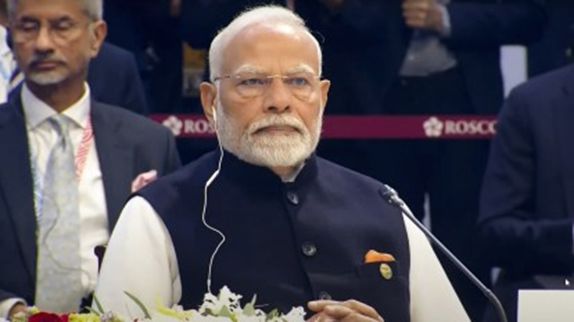
TOKYO, JAPAN – Prime Minister Narendra Modi, in a landmark address to the India-Japan Economic Forum in Tokyo today, Friday, August 29, 2025, pitched a powerful vision for a new global technology revolution led by the combined strengths of the two nations. He declared that the synergy of “Japanese technology and Indian talent” holds the key to shaping the tech landscape of the 21st century.
PM Modi, who is on a two-day official visit to Japan, underscored India’s rapid transformation, highlighting its political and economic stability, transparency in policies, and predictability. He noted that India is currently the fastest-growing major economy and is on track to become the world’s third-largest economy. This progress, he stated, is driven by the government’s “Reform, Perform, and Transform” approach.
During his speech, the Prime Minister emphasized the deepening economic ties between the two countries, noting that Japanese companies have already invested over $40 billion in India. He urged Japanese businesses to “Make in India, Make for the world,” citing the successful collaborations in the manufacturing and auto sectors, particularly the success stories of companies like Suzuki and Daikin. He called for this success to be replicated in other key areas, including batteries, robotics, semiconductors, shipbuilding, and nuclear energy.
In a significant announcement, PM Modi revealed that after opening up the defense and space sectors, India is now inviting private sector participation in the nuclear energy sector. He pointed to India’s ambitious initiatives in cutting-edge fields like AI, semiconductors, quantum computing, biotechnology, and space as evidence of the country’s potential.
Japanese Prime Minister Shigeru Ishiba echoed PM Modi’s sentiments, highlighting the complementary nature of Japan’s advanced technology and India’s outstanding talent. He stated that the signing of new cooperation documents between companies from both nations is a clear signal of Japan’s commitment to further increasing its investment in India and building a robust supply chain centered around the two countries.
