


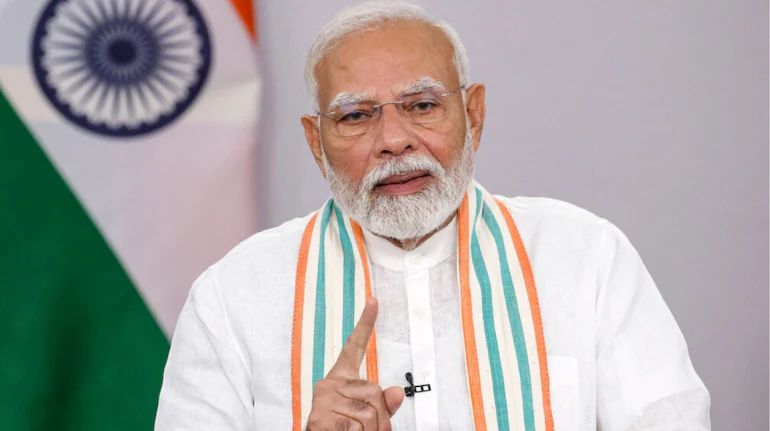
New Delhi – Prime Minister Narendra Modi addressed the nation today, extending Navratri greetings and announcing a new chapter in India’s economic history. Beginning tomorrow, September 22, the “Next Generation GST reforms” will take effect, marking the start of a “GST Bachat Utsav” or savings festival for citizens.
In a move aimed at simplifying the tax structure and boosting consumption, the previous multi-slab GST system will be replaced by a streamlined two-rate structure of 5% and 18%. This significant overhaul, approved during the 56th GST Council meeting, is expected to make most everyday items more affordable for millions of households.
The new GST framework replaces the previous four-slab system of 5%, 12%, 18%, and 28%. According to the Prime Minister, this change will primarily leave only two main slabs:
5% Slab: This lower rate will apply to most daily-use essentials, including food items, medicines, soaps, and other toiletries. The PM stated that 99% of items previously taxed at 12% will now fall under this 5% bracket.
18% Slab: This will be the standard rate for most goods and services. A separate 40% rate will apply to luxury and “sin” goods like high-end cars and tobacco products.
The Prime Minister emphasized that these changes will benefit the poor, the middle class, and the “neo middle class,” a group of 25 crore Indians who have recently moved out of poverty.
Prime Minister Modi highlighted that the combination of recent income tax relief (making income up to ₹12 lakh tax-free) and the new GST reductions will save Indian citizens more than ₹2.5 lakh crore in the coming year.
The reforms are designed to stimulate the economy by putting more money directly into the hands of consumers. Finance Minister Nirmala Sitharaman stated that the new tax regime will inject an estimated ₹2 lakh crore into the economy. This is expected to boost demand and consumption, which in turn will support growth and improve business operations for MSMEs, small-scale industries, and cottage enterprises.
Specific items seeing a significant drop in GST rates include:
Appliances: Air conditioners and televisions (above 32 inches) will now be taxed at 18%, down from the previous 28%.
Automobiles: Small cars and motorcycles with an engine capacity up to 350cc will see their GST rate drop from 28% to 18%.
Healthcare: Life and health insurance premiums will be fully exempt from GST, a sharp reduction from the previous 18% rate. Additionally, essential medicines and diagnostic kits will be taxed at only 5%.
In his address, the Prime Minister connected the GST reforms to the “Aatmanirbhar Bharat” (Self-Reliant India) campaign. He urged citizens to embrace the “Swadeshi” mantra by prioritizing products that are “Made in India,” which he said are a result of the hard work and dedication of the nation’s youth. The Prime Minister called on all state governments to support this initiative by fostering a favorable environment for investment and manufacturing in their respective regions.
He expressed confidence that these reforms will accelerate India’s growth story, simplify business, and make the country a more attractive destination for investors.
